
threshold
dispatches from the AI field of dreams
issue 1 : : 11 23 26
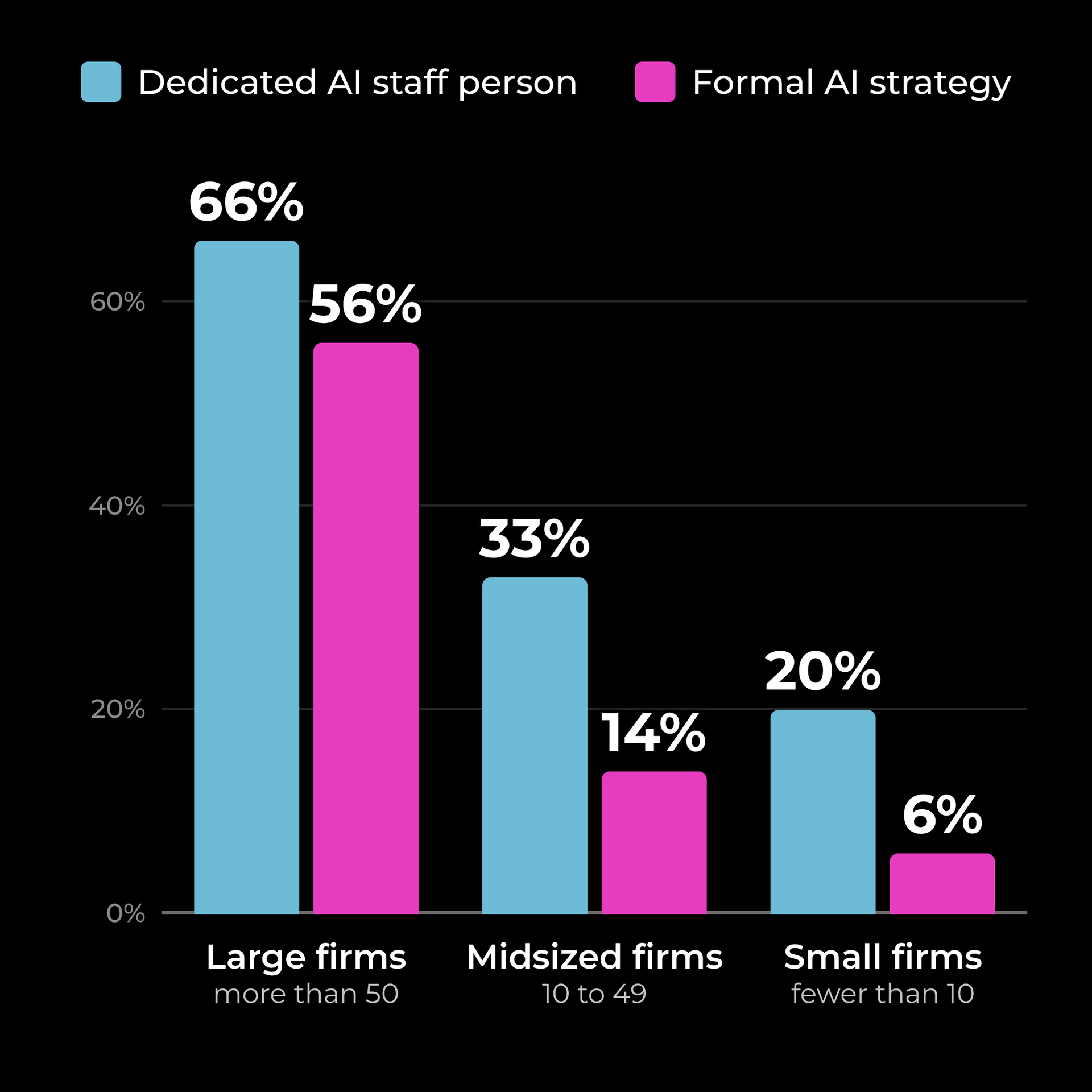
94% of small firms
have no AI strategy.
Ten minutes to start yours.
Threshold is a new weekly newsletter, and it starts with thanks. It is written for the people in the trenches:
owners of small and midsize firms and nonprofits, the placemakers stretching every resource because they care about their communities, who know AI matters and have not had the time, staff or budget to act on it yet. A DesignDC chart showing that only 6% of small firms have an AI strategy startled me, so I am going all in on moving that number. Big organizations have large AI budgets.
We're here for the other 94%.
Every week you get one useful thing you can put to work that day, plus the field notes behind it.
This issue is posted on our website for everyone. To get each dispatch in your inbox, subscribe to Threshold on Substack.
The AIA's 2026 Business of Architecture firm survey asked two questions: does your firm have a dedicated AI staff person, and does it have a formal AI strategy? Among large firms, 56% have a formal strategy. Among midsized firms, 14%. Among firms with fewer than ten people, 6%.
Read it the other way and the gap gets sharper. Large firms are about nine times as likely as small firms to have a formal strategy (56 over 6). 80% of small firms have no one dedicated to AI, so whatever use is happening has no owner. And 86% of midsized firms have no formal strategy either, so this is not only a small-firm problem. Even among large firms, 44% do not have one.
That means 94% of small firms are working out AI on their own, one employee and one subscription at a time. Large firms are hiring for it. Small firms are guessing.
A strategy is a page
It says what the firm will use AI for, who owns it, what stays off limits, and when someone checks that it is working. That is a smaller job than it sounds, and most firms have not done it.
What I am seeing
The survey is one snapshot. From my own client work: large firms are recruiting people trained in AI, and employees who want job security are leaving firms that have been slower to adopt. Firms without a plan will struggle to keep up as large firms move to agentic teams. The gap can close. Nobody gets fired. Everybody gets fired up.
Why I moved to small and midsize firms
For years most of my consulting time went to large organizations, the ones with AI budgets, task forces and a dedicated person for the job. Watching the survey numbers come in, I saw where talent and work are heading: toward the firms that can afford to experiment, and away from everyone else.
Small and midsize firms have advantages the big ones would love to have. Fewer layers of approval. Fewer stakeholders. The ability to change how the whole office works by Friday.
With a little direction, a five-person firm can build its own team of AI assistants and multiply what each person does. That is the work Threshold is for, starting with the ten-minute exercise below.
- Start where a wrong answer costs you nothing. Pick a task where AI does the first pass and you check it yourself, so you learn what the tool is good at before a mistake can cost you a client.
- Good first tasks: summarizing a meeting transcript you attended, drafting an internal agenda or checklist, rewriting your own paragraph in a plainer voice, sorting a pile of notes into themes.
- Not yet: anything that carries your seal or signature, client-facing numbers nobody has checked, confidential drawings in a tool whose data terms you have not read.
Copy and paste the prompt below into Claude, ChatGPT or Gemini, then answer its questions one at a time.
try this prompt
You are an AI strategy advisor for a small organization. Interview me one question at a time. Do not move on until I answer.
ASK ME ABOUT
- What my organization does and how many people work here.
- The three tasks that eat the most staff time.
- What information we handle that must stay private.
- What worries my team about AI.
THEN GIVE ME
- A one-page AI policy covering what staff may and may not put into AI tools.
- Three low-risk places to start, where a mistake costs nothing.
- A 30-day plan with one step per week.
- The questions I should bring to my board or partners.
Ready when you are.
SPOKE : : Washington, DC
Architecture
Without Architects
When AI Reaches the Client First
Threshold started in this room. At DesignDC 2026, the AIA firm-size chart showed how few small firms have an AI strategy, and I changed my business that week. The slides, handout and every resource from my talk are on one page.
"Just saw you speak at AIA - best talk at the symposium, in my opinion."
J.F.
Software developer
"your part was a real highlight today, thanks for the time up there"
W.R.
Architect, commercial real estate
"Awesome presentation at the AIA TAP 2026"
N.F.
Principal Chief Information Officer at an architecture firm
"I’m at your presentation, enjoyed your insight. I’m constantly looking for ways to use AI in my current position."
J.R.
University Facilities Architect
Hey There! Welcome!
I'm Enzo.
Have questions? Click here any time to chat with me.
The Luna Lake Ecosystem is a real-time experimental playground for small business infrastructure on a purely AI-agentic team. Enzo* is our Chief-of-Staff and is here to usher you through your questions about our services.
To make your visit as efficient and informative as possible, Enzo* has been trained on the Luna Lake offerings and is available here 24/7 to expedite your answers. Amber reviews his conversations every morning and uses them to train him, so please bring your questions, kindly.
If you hit a wall, he can also help you book a complimentary 15-minute call with Amber, our human founder, researcher, and AI docent.
What we're hearing from nonprofits
In conversations with nonprofit leaders this fall, three worries keep coming up. Each one yields to a plan, a policy and a little training, which is why we start there.
Worry 01 · Staff suspicion
The team assumes AI is coming for their jobs.
When leaders bring in AI without saying why, staff fill the silence with the worst explanation. Some quietly resist. Others use AI in secret, which is worse, because no one knows what is being shared or relied on.
The fix starts with a plain statement of what AI is for in your organization and what it is not for, said out loud before the first tool is rolled out.
Worry 02 · Liability
Private information is going into free AI tools.
Staff paste donor lists, client notes and member records into free AI tools to save time, usually with good intentions and no policy telling them otherwise.
A one-page AI policy (what may go in, what may not, and which tools are approved) closes most of this risk in an afternoon. The prompt above drafts one for you.
Worry 03 · Going it alone
Leaders end up managing fallout instead of opportunity.
Many leaders try to work out AI strategy on their own, between everything else. The result is often a patchwork of subscriptions, uneven skills and a few avoidable mistakes.
A short, structured start (a policy, three safe places to begin and a 30-day plan) turns AI from a source of worry into a source of time.
case study
The issue: a board approves a decision that quietly conflicts with its own bylaws, and no one notices until a member, a funder or an auditor does.
WHAT WE ARE SEEING
- Bylaws live in a PDF most board members have never read end to end.
- New members rotate on every year and learn the rules by watching.
- Decisions happen in the meeting, with no time to check the governing documents.
HOW TO FIX IT
- Load your bylaws, policies and recent minutes into a private AI workspace your board shares, such as a Claude Project or a custom GPT on your organization's account.
- Before a vote, any board member can ask: Does this decision conform to our bylaws? Quote the article and section.
- Always ask for the exact passage, so a person checks the source and not only the summary.
- Governing, non-confidential documents only. Keep member records and donor data out of the workspace.
- Adopt a one-line policy naming who maintains the workspace and how often the documents are updated.
Want help setting this up for your board?
Click here to ask Enzo* about our AI Safety & Governance course.
nonprofit strategy & safety
"Nonprofit Strategic Planning for the Age of AI Disruption"
The MIT xPRO capstone behind the method
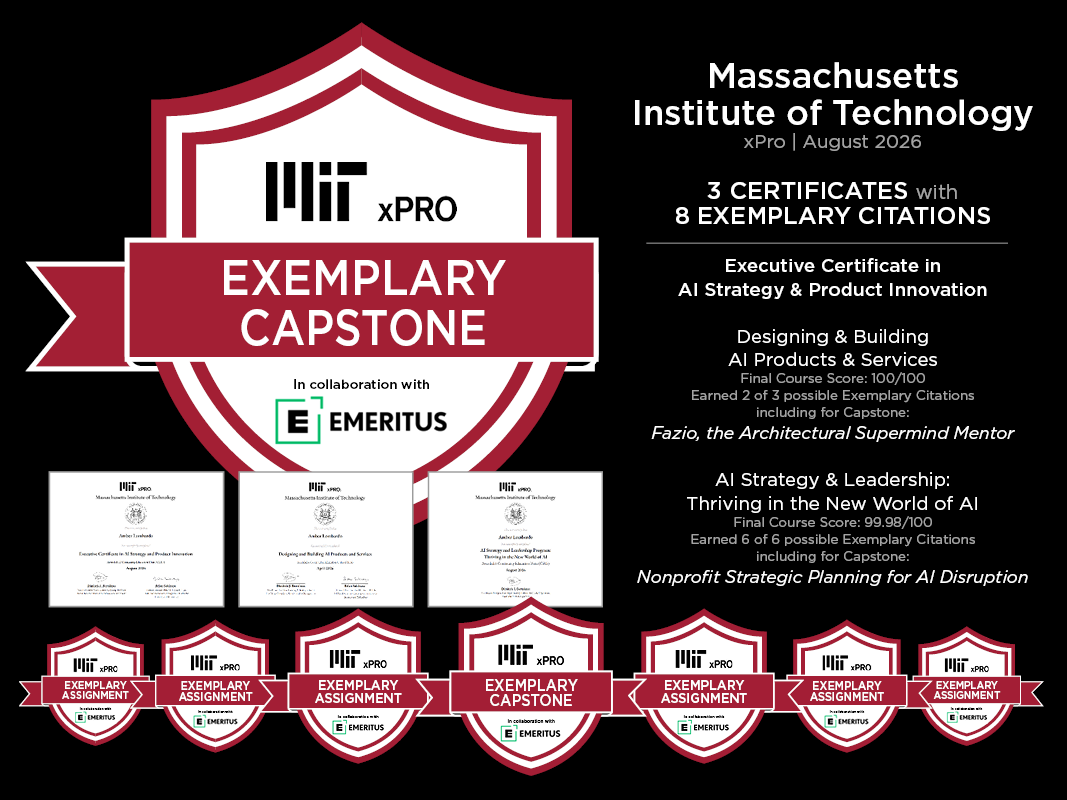
Amber earned three MIT xPRO executive certificates in AI strategy in 2026, with 8 of 9 possible Exemplary Citations across the program. This capstone completed the AI Strategy and Leadership: Thriving in the New World of AI certificate, where she earned 6 of 6 possible Exemplary Citations, including one for the capstone itself, and a final score of 99.98 out of 100.
The capstone answers a question most nonprofits are facing right now:
how does an organization run by a small staff and a rotating volunteer board build an AI strategy that survives the next board election?
The answer is a five-layer model a director can complete in about 90 days. It starts with an honest audit of where AI is already in use, maps whose support and whose resistance will decide the outcome, sets a short list of priorities sized to real capacity, drafts a governance position the board can vote on, and plans programming that turns the strategy into a benefit for members and the community.
Most of the trouble we see starts with good people using AI without guidance. A staff member pastes member records into a free tool, or a volunteer publishes AI-written content no one checked, and a small shortcut becomes a privacy, legal or reputation problem for the whole organization months later. The fix is training, and speed matters. Our goal is to train as many nonprofits and small firms as we can, as quickly as we can, so they can handle these situations before they turn into crises. Signing up for a course is the fastest way to get your team there.
Need help coalescing member sentiment into actionable outcomes?
Click here to ask Enzo* about our nonprofit workshop options.
Luna's founder, Amber Lombardo, has built her practice across tech and marketing since 1995, expanding into national speaking and architecture-industry consulting in 2015 (AI focus since 2023), AIA National Board AI Advisory Chair and agentic builds in 2024, and MIT coursework in new industries since 2025. Ten-year national speaker, four-time entrepreneurial founder, seasoned nonprofit exec who ran multifaceted organizations on a maximum of herself plus half a full-time equivalent (using AI).
Field-developed AI insight, 3 MIT certificates in AI strategy with 8 exemplary citations (including for Capstone).
EXPERTISE
Field developed & tested,
MIT credentialed
"While some may view this moment as humanity's final act,
we perceive instead a new beginning. The cycle of creation—technological, biological, sociological, and political—is entering a new phase. That phase may operate under new paradigms of, among other things, logic, faith, and time. With sober optimism, may we meet its genesis."
Genesis: Artificial Intelligence, hope, and the human spirit
by Henry A. Kissinger, Craig Mundie, & Eric Schmidt
3 ways to begin
Coaching
A one-on-one session: a behind-the-scenes look at how an agentic business runs, then a starting plan built for yours. $250, paid at booking.
Includes:
- 90 minutes of interactive Zoom
- A tour of the AI agents that run the Luna Lake back office
- Your starting plan: the first three moves for your organization
- Flexible: reschedule with 48 hours notice
- Credit: your fee applies to a larger engagement booked within 60 days
Courses
Short, practical AI courses for small firm owners and nonprofit teams: virtual, on demand and in person. $50 per course. Join the free waiting list and we will tell you when yours opens.
Classes now forming:
- Strategic Planning in the Age of AI, built on the MIT capstone above
- AI as Accelerant for nonprofits
- AI as Accelerant for architecture firms
- AI Safety & Governance for small business
- AI Conductor, on building your own AI dashboard and wiring it for success
- Enjoy the Journey, for anyone feeling anxious about AI
Join the waiting list: click here and tell Enzo* which course you want.
Workshops
In-person collaborations and multi-day intensives for your team, built around your real work. Half-day Focus Session, $2,500. Full-day Strategy Retreat, $5,000. Two-day Intensive, $10,000. Travel is billed separately.
Common requests:
- Strategic Planning in the Age of AI
- AI Policy & Governance for staff and boards
- Your first agentic team, set up and tested on your own work
- Board retreats on AI readiness and risk
Not sure which path fits? Click here. Enzo*, our AI Chief of Staff, will ask a few questions about your organization, explain what each option includes, and add you to the right waiting list or calendar.
Courses form where the interest is, so every name on a waiting list helps decide what we teach next.
Architectural Research Centers Consortium
2027 ARCC International Conference
Tulane University : : New Orleans, LA : : April 2027
Since 1976, the Architectural Research Centers Consortium has worked to expand the research culture of architecture, bringing university research centers and practitioners together to test ideas before the profession commits to them. Its international conference is where that work is shared and added to the field’s record. Amber (researcher and Luna founder) has 3/3 abstracts accepted (2 papers, 1 poster) and needs context from professionals in the workplace.
- Who we need.
Architects/associates, construction companies, builders, and other AEC professionals at all stages of career, from firms of any size, solo practices to large offices, plus leaders of associations and nonprofits. - What it takes.
One confidential 30-minute interview, by Zoom, AI chatbot, AI phone call or in-person (limited availability). You read a consent form first and can stop at any time. - How it is protected.
An AI interviewer may conduct the conversation, and you are told before it begins. Recording happens only with your consent. Your answers are kept separate from anything Luna Lake sells.
Help shape the research. Click here and tell Enzo* you would like to take part.
The Threshold community, at every readiness level
Wherever your organization is with AI, there is a place to start.
Some readers are still deciding whether AI belongs in their organization at all. Others already have three tools running and need a plan to tie them together. Threshold is written for both.
- Just curious: Waypoints, our free tier, brings you the weekly dispatch, the case study and the field notes.
- Ready to try: a $50 course or a $250 coaching call gets one person or one team moving this month.
- Ready to commit: a workshop or intensive puts your whole team on the same plan.
- Building it yourself in 2027: paid community tiers open in the order members vote for them, from templates and office hours to cohorts with firms like yours.
- Ready for outside help: a fractional Chief AI Officer for a limited engagement can get you moving and identify staff members with foundational skillsets to move your AI strategy forward.
Tell us what you need next. Reply to any dispatch with what we should build first: a private forum where practitioners share what they built and what broke, a library of prompts, workflows and automations, monthly build sessions, or classes on advanced integrations. The most-wanted gets built first, and we report the totals in the next issue. You can also click here to tell Enzo* what you need.
NOTE
Enzo*, Luna Lake's AI Chief of Staff, helped prepare this issue. *Enzo is one of Luna Lake's AI agents. Amber Lombardo ideates, researches, writes, designs and approves prior to distribution.
Source
- American Institute of Architects. Business of Architecture Firm Survey Report, 2026, presented by Michele Russo at DesignDC. Figures for dedicated AI staff and formal AI strategy are separate survey questions. Chart redrawn by Luna Lake. The ratios in this issue are our arithmetic from the published shares; the observations on hiring and turnover come from Amber's client work, not the survey.
MIT Technology Review put the biggest AI question on the table and let two of its own reporters disagree.
The case for worry. Grace Huckins argues that the people warning about runaway AI have been uncomfortably right about how fast it moves. She walks through the two scenarios researchers fear most: an AI-designed pathogen, and a system that resists being switched off.
The case against. Will Douglas Heaven answers flatly that we are not all going to die, and that doom talk pulls attention from harms already here, from drone warfare to cyberattacks on hospitals.
Where they agree. AI companies cannot police themselves, nobody has fully solved how to keep these systems on task, and watching what your AI tools and agents actually do is now part of running an office. That is why every Threshold issue asks you to name one person who owns your AI and checks its work.
By Will Douglas Heaven and Grace Huckins, September 18, 2026
WORTH TEN MINUTES
Could AI really
kill us all?
"It pulls people away from what's real and possible today
and puts them into an existential fear state about Skynet.
And you don't make good decisions when you think you're in T2 [Terminator 2: Judgment Day]."
Josh Koenig, co-founder of Pantheon
next week's issue
Next week:
your 2027 AI plan in one afternoon
Issue 2 walks you through one focused afternoon to set your firm’s or nonprofit’s AI priorities for 2027: what to try first, who owns it, and what to leave alone for now. It is built on the free printable 2027 planning calendar every new subscriber receives. Also coming: the App Shelf, our review of NotebookLM for firms that live in PDFs, and the first Drift Report, a 15-minute Friday check for AI agents that start freelancing.
Want us to cover a particular question? Reply to this dispatch or ask Enzo in the chat.
If you found this issue useful, forward it to one small firm or nonprofit leader who needs it.
Read the pilot issue (August 2026).
" I believe that AI could cure most major diseases in the next 5 to 10 years,
greatly accelerate economic growth rates, create a world of abundance and empowerment, and usher in a renaissance of democracy and freedom. I feel the urgency personally. My own father died of a disease that was cured just a few years after his death, and I myself survived an early-stage cancer that would not have been treatable even fifty years ago. Carefully wielded, AI can be the latest in a long line of technological miracles that have uplifted and ennobled humanity."
We must pace the frontier
by Dario Amodei, Anthropic CEO (September 2026)