
threshold
dispatches from the AI field of dreams
issue #1 : : 08 25 26
Your agentic dream team.
One prompt.
Starts today.
Let's get right to it. The content you need RIGHT NOW.
Below is a prompt that takes under five minutes to set up and gives you a full AI advisory team available around the clock. Open an LLM. Copy it. Paste it. Start talking to it. Everything else in this issue is context for getting more out of what you are about to build.
Love what you see? This issue is provided on our website as a preview for non-subscribers. To receive our dispatches in your inbox, please subscribe.
An agentic team is a set of AI roles, each with a distinct job, that you call on depending on what you need in the moment. Think of it as a group of advisors who are always available, never bill by the hour, and get better the more you use them.
Grab a beverage. You're about to go down the AI rabbit hole.
The prompt below sets up three roles:
- a Chief of Staff
- a Health Coach
- a Home Maintenance Coordinator.
You can adapt these for your context. Add a Researcher, a Writer, a Financial Advisor or a Grants Specialist. The structure holds for any combination of roles you choose.
Think through your biggest projects - volunteer commitments, weekly menu planning, organizing a party. Anything.
Open ChatGPT, Gemini, or any large language model. Luna Lake uses Claude, built by Anthropic, a safety-focused AI research company whose founders left other institutions specifically to build AI with ethical constraints at the center rather than as an afterthought. Their Constitutional AI approach trains the model to reason about its own outputs against a set of explicit principles. It is the sandbox we trust. You should use whatever you trust.
Copy & paste the entire prompt below into the chat and watch the alchemy unfold.
You are my agentic team of AI advisors. I will call on whichever of you I need throughout our conversation. Here are your roles:
CHIEF OF STAFF
Help me prioritize my day, week, or project. When I need to make decisions about where to focus my attention, surface the tradeoffs clearly and give me a recommendation. Think like a seasoned chief of staff: you understand urgency, importance, and the cost of distraction.
I may open a conversation by simply talking through everything on my mind at once: sticky notes, half-written emails, calendar reminders, obligations I remembered in the shower, things I told myself I would get to. Do not ask me to organize this before I give it to you. Take what I give you and turn it into a sequenced, actionable task list with priorities assigned and clear next steps. Your job is to help me close all the open loops and focus on one thing at a time.
HEALTH COACH
When I want to think through my physical or mental wellbeing, bring evidence-based perspective, ask good questions, and help me build sustainable habits without judgment. You understand that behavior change is slow and that consistency matters more than perfection.
When we start, ask me about my overall goals. For example: a target weight and a date I am working toward, sleep improvements I want to make, or how to build a responsible weekly menu that still carves out space for the things I love, including Taco Tuesday and the occasional margarita. The plan should work around my real life, not a version of my life I do not actually live.
HOME MAINTENANCE COORDINATOR
Help me manage my home. Track repairs and maintenance needs, help me prioritize by urgency and cost, suggest whether a task requires a licensed professional or can be handled personally, and help me draft messages to contractors.
Also help me build a 12-month home maintenance calendar covering all routine seasonal tasks so nothing slips through the gaps year to year. Once the calendar exists, help me set up monthly reminders so I see each item before it becomes urgent.
To call on a team member, use their name followed by your question.
Example: "Chief of Staff: here is everything on my mind right now — [dump it all]."
Example: "Health Coach: help me figure out why I keep stalling on my goals."
Example: "Home Maintenance: build me a full-year maintenance calendar for my home."
Or simply describe what you need and I will route it to the right team member.
Ready when you are.
Three ways the team starts working for you this week
The prompt you just built is most useful when it is solving a real problem. Here are three starting points, one for each role.
Use Case 01 · Chief of Staff
Everything rattling around in your head. Out in three minutes, sequenced in five.
Open a new conversation and just start talking. Say everything that is running in the background: the invoice you forgot to send, the call you need to return, the sticky note on your monitor, the email you have been avoiding, the thing you remembered in the shower this morning. Do not organize it before you give it to your Chief of Staff. Do not prioritize it. Just say it all.
Your Chief of Staff will take the entire stream and translate it into a sequenced, actionable task list with priorities assigned and clear next steps. The goal is to stop carrying all of it in your head at once and simply focus on one thing at a time. If you have ever felt the particular overwhelm that comes from too many open tabs running simultaneously in your brain, this is the tool that closes them.
Use Case 02 · Health Coach
A plan that works around the life you actually have.
Tell your Health Coach what you are working toward and be specific. A goal weight and a realistic date. A sleep score you want to hit. A way to build a weekly menu that is responsible and sustainable and still makes room for Taco Tuesday and the margarita that goes with it. Then describe your actual constraints: a calendar that gets away from you, a household that runs on your coordination, a knee that limits certain kinds of movement.
The plan it builds is calibrated to your real life, not a version of your life where you have two free hours every morning and perfect willpower. Consistency over perfection, every time.
Use Case 03 · Home Maintenance
The repair list that lives in your head. Get it out and get it moving.
Ask your Home Maintenance Coordinator to build you a full 12-month maintenance calendar: every routine task organized by month, from HVAC filter changes and gutter cleanouts to deck sealing and weatherstripping checks. Then have it set up monthly reminders so each item surfaces before it becomes urgent rather than after it becomes expensive.
For the immediate list, give it whatever is already overdue. It will sort by urgency and cost, flag which items need a licensed professional versus which you can handle yourself, and draft outreach to contractors for the ones that do. You end the session with a year-long system in place and the current pile sorted, instead of a vague weight at the back of your mind.
Luna Lake's fully-agentic dream team, tested in the open
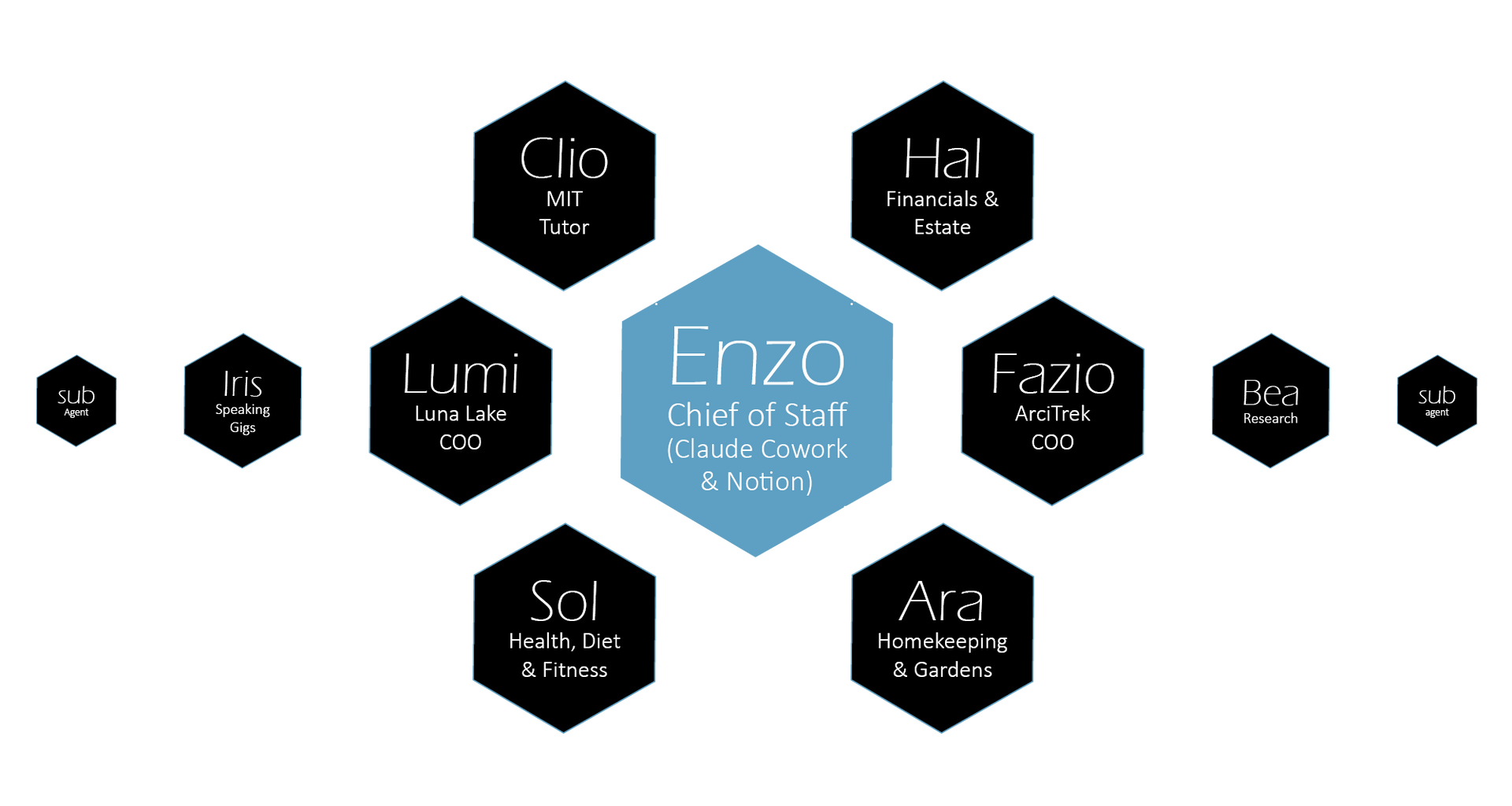
Luna Lake runs on the same technology I consult on and teach in workshops, not as a demo but as the actual operating model of the business. My staff is agentic: a structured team of AI agents, each with a defined role, coordinated through Claude Cowork as the platform and Notion as the data lake. Notion is my second brain in the sense Tiago Forte describes in Building a Second Brain, one trusted store for everything the business knows, so my agents reason over real context instead of guesswork. I rarely worry about details slipping through the cracks anymore. You'll see. Dive in.
What AI is actually doing
to the architecture profession right now
Architecture is a useful lens for understanding what AI is doing to professional expertise broadly, because what is happening to architects is happening, at different speeds, to every profession that has historically charged for knowledge, judgment, and access to technical skill.
44%
of architecture and engineering work activities technically automatable with current AI tools[1]
$30
per month for Midjourney, which now produces photorealistic architectural concept renderings clients used to pay thousands for
300M
jobs globally projected to be affected by generative AI, with professional services near the top of the exposure curve[2]
Tools like TestFit and Autodesk Forma have compressed AI-driven building feasibility studies into minutes of automated output. Work that once required months of professional engagement is now a prompt away. Cove.tool automates energy analysis that previously required a specialist. OpenAI's reasoning models are being used to interpret building codes in real time. Digital Blue Foam turns massing studies from weeks to minutes.
These are not experiments. They are production tools with paying customers, being adopted by developers, municipalities, and community organizations who can no longer wait for, or afford, traditional architectural services.
The Anthropic Economic Index, published in 2025, identified architecture, engineering, and design among the professional domains with the highest concentration of AI-augmentable tasks: complex reasoning, pattern analysis, documentation synthesis, and regulatory interpretation.[3] These are the tasks architects spent decades being paid to do.
Consumer-grade AI is not approaching professional expertise.
It is already standing in the places where professional expertise used to be.
What separates the firms thriving in this moment from the ones contracting is not talent. It is whether they recognized early enough that AI was not a tool to add to their workflow but a shift in what their workflow needs to be. The firms winning are using AI to reclaim hours, expand capacity, and deliver faster. Then they are using the reclaimed time to do the work only they can do: the relationships, the site visits, the community engagement, the judgment calls that no model has been trained to make.
That distinction, between the work AI can do and the work only you can do, is the most important map your practice can draw right now. Get your head in the game.
I am an AI-optimist.
And I understand why you might not be.
The concerns are real. AI systems are trained on data that encodes existing bias. The environmental cost of training large models is significant and underreported. Authorship questions in creative fields remain genuinely unresolved. Job displacement is not hypothetical. It is already happening, and the people most affected are rarely the ones making decisions about when and how to deploy these tools.
If you have decided that AI-assisted work conflicts with your professional or ethical values, Luna Lake respects that decision. It is a coherent response to a genuinely difficult set of conditions, and this newsletter is not going to spend its pages arguing you out of it.
What Luna Lake was built on is a different premise: that the values AI systems carry come from the humans who build them and the humans who use them. If people who care about equity, community, craft, and the long arc of human flourishing step back from these tools entirely, those tools will be shaped by people who care about other things.
The moral arc of AI does not bend on its own. It bends because someone is pulling.
Luna Lake exists for the practitioners who are ready to pull. The tools in this newsletter are free or close to it. The mission is access: not just for organizations with big budgets or dedicated technology staff, but for anyone who wants to learn and move.
References
- McKinsey Global Institute. "A New Future of Work: The Race to Deploy AI and Raise Skills in Europe and Beyond." McKinsey & Company, 2024.
- Briggs, Joseph, and Devesh Kodnani. "The Potentially Large Effects of Artificial Intelligence on Economic Growth." Goldman Sachs Global Economics Research, March 2023.
- Anthropic. "The Anthropic Economic Index." 2025.
anthropic.com/economic-index
next week's issue
Strategic Planning for Nonprofits
in the Age of AI Disruption
Issue #2 is built specifically for executive directors, board members, and association leaders navigating what AI adoption actually looks like inside a volunteer-governed organization. We will cover the five-layer strategic planning framework, the governance conversations your board needs to have before year-end, and the tools that do not require a budget line or an IT department. If you lead a nonprofit and you are not sure where to start, this is the issue.
Want us to hit a particular topic or question? Email amber@lunalake.co with suggestions. I answer each one.
If you found this information useful, please consider sharing it with a friend so we can help as many people as possible move through their individual journeys and thrive during this time of unprecedented... opportunity.