
threshold
dispatches from the AI field of dreams
issue #2 : : 11 18 26
94% of small firms
have no AI strategy.
Ten minutes to start yours.
Threshold is back, rebuilt for a new reader:
the owner of a small firm or organization who knows AI matters and has not had the time, staff or budget to act on it yet. Big organizations have large AI budgets.
We're here for the other 94%.
Every week you get one useful thing you can put to work that day, plus the field notes behind it.
This issue is posted on our website for everyone. To get each dispatch in your inbox, subscribe to Threshold on Substack.
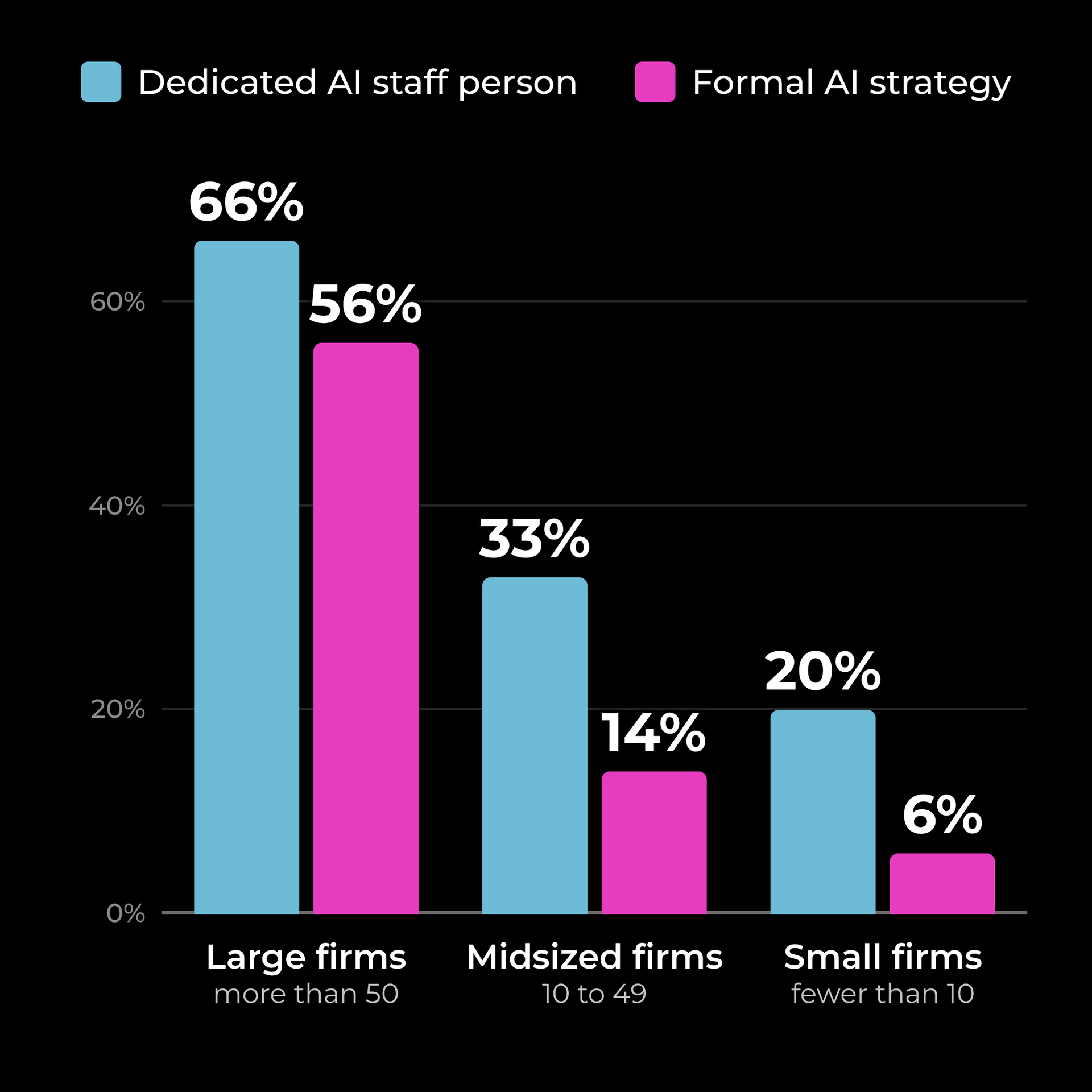
The AIA's 2026 Business of Architecture firm survey asked two questions: does your firm have a dedicated AI staff person, and does it have a formal AI strategy? Among large firms, 56% have a formal strategy. Among midsized firms, 14%. Among firms with fewer than ten people, 6%.
Read it the other way and the gap gets sharper. Large firms are about nine times as likely as small firms to have a formal strategy (56 over 6). 80% of small firms have no one dedicated to AI, so whatever use is happening has no owner. And 86% of midsized firms have no formal strategy either, so this is not only a small-firm problem. Even among large firms, 44% do not have one.
That means 94% of small firms are working out AI on their own, one employee and one subscription at a time. Large firms are hiring for it. Small firms are guessing.
A strategy is a page
It says what the firm will use AI for, who owns it, what stays off limits, and when someone checks that it is working. That is a smaller job than it sounds, and most firms have not done it.
What I am seeing
The survey is one snapshot. From my own client work: large firms are recruiting people trained in AI, and employees who want job security are leaving firms that have been slower to adopt. Firms without a plan will struggle to keep up as large firms move to agentic teams. The gap can close. Nobody gets fired. Everybody gets fired up.
Why I moved to small firms
For years most of my consulting time went to large organizations, the ones with AI budgets, task forces and a dedicated person for the job. Watching the survey numbers come in, I saw where talent and work are heading: toward the firms that can afford to experiment, and away from everyone else.
Small firms have advantages the big ones would love to have. Fewer layers of approval. Fewer stakeholders. The ability to change how the whole office works by Friday.
With a little direction, a five-person firm can build its own team of AI assistants and multiply what each person does. That is the work Threshold is for, starting with the ten-minute exercise below.
- Start where a wrong answer costs you nothing. Pick a task where AI does the first pass and you check it yourself, so you learn what the tool is good at before a mistake can cost you a client.
- Good first tasks: summarizing a meeting transcript you attended, drafting an internal agenda or checklist, rewriting your own paragraph in a plainer voice, sorting a pile of notes into themes.
- Not yet: anything that carries your seal or signature, client-facing numbers nobody has checked, confidential drawings in a tool whose data terms you have not read.
Copy and paste the prompt below into Claude, ChatGPT or Gemini, then answer its questions one at a time.
try this prompt
You are an AI strategy advisor for a small organization. Interview me one question at a time. Do not move on until I answer.
ASK ME ABOUT
- What my organization does and how many people work here.
- The three tasks that eat the most staff time.
- What information we handle that must stay private.
- What worries my team about AI.
THEN GIVE ME
- A one-page AI policy covering what staff may and may not put into AI tools.
- Three low-risk places to start, where a mistake costs nothing.
- A 30-day plan with one step per week.
- The questions I should bring to my board or partners.
Ready when you are.
Hey There! Welcome!
I'm Enzo.
Have questions? Simply click the magenta chat bubble at the bottom right of your screen at any time.
The Luna Lake Ecosystem is a real-time experimental playground for small business infrastructure on a purely AI-agentic team. Enzo* is our Chief-of-Staff and is here to usher you through your questions about our services.
To make your visit as efficient and informative as possible, Enzo* has been trained on the Luna Lake offerings and is available here 24/7 to expedite your answers. Amber reviews his conversations every morning and uses them to train him, so please bring your questions, kindly.
If you hit a wall, he can also help you book a complimentary 15-minute call with Amber, our human founder, researcher, and AI docent.
What we're hearing from nonprofits
In conversations with nonprofit leaders this fall, three worries keep coming up. Each one yields to a plan, a policy and a little training, which is why we start there.
Worry 01 · Staff suspicion
The team assumes AI is coming for their jobs.
When leaders bring in AI without saying why, staff fill the silence with the worst explanation. Some quietly resist. Others use AI in secret, which is worse, because no one knows what is being shared or relied on.
The fix starts with a plain statement of what AI is for in your organization and what it is not for, said out loud before the first tool is rolled out.
Worry 02 · Liability
Private information is going into free AI tools.
Staff paste donor lists, client notes and member records into free AI tools to save time, usually with good intentions and no policy telling them otherwise.
A one-page AI policy (what may go in, what may not, and which tools are approved) closes most of this risk in an afternoon. The prompt above drafts one for you.
Worry 03 · Going it alone
Leaders end up managing fallout instead of opportunity.
Many leaders try to work out AI strategy on their own, between everything else. The result is often a patchwork of subscriptions, uneven skills and a few avoidable mistakes.
A short, structured start (a policy, three safe places to begin and a 30-day plan) turns AI from a source of worry into a source of time.
case study
The issue: a board approves a decision that quietly conflicts with its own bylaws, and no one notices until a member, a funder or an auditor does.
WHAT WE ARE SEEING
- Bylaws live in a PDF most board members have never read end to end.
- New members rotate on every year and learn the rules by watching.
- Decisions happen in the meeting, with no time to check the governing documents.
HOW TO FIX IT
- Load your bylaws, policies and recent minutes into a private AI workspace your board shares, such as a Claude Project or a custom GPT on your organization's account.
- Before a vote, any board member can ask: Does this decision conform to our bylaws? Quote the article and section.
- Always ask for the exact passage, so a person checks the source and not only the summary.
- Governing, non-confidential documents only. Keep member records and donor data out of the workspace.
- Adopt a one-line policy naming who maintains the workspace and how often the documents are updated.
Want help setting this up for your board?
Click the pink chat bubble at the bottom right of your screen and ask Enzo* about our AI Safety & Governance course.
nonprofit strategy & safety
"Nonprofit Strategic Planning for the Age of AI Disruption"
The MIT xPRO capstone behind the method
Amber earned three MIT xPRO executive certificates in AI strategy in 2026, with 8 of 9 possible Exemplary Citations across the program. This capstone completed the AI Strategy and Leadership: Thriving in the New World of AI certificate, where she earned 6 of 6 possible Exemplary Citations, including one for the capstone itself, and a final score of 99.98 out of 100.
The capstone answers a question most nonprofits are facing right now:
how does an organization run by a small staff and a rotating volunteer board build an AI strategy that survives the next board election?
The answer is a five-layer model a director can complete in about 90 days. It starts with an honest audit of where AI is already in use, maps whose support and whose resistance will decide the outcome, sets a short list of priorities sized to real capacity, drafts a governance position the board can vote on, and plans programming that turns the strategy into a benefit for members and the community.
Most of the trouble we see starts with good people using AI without guidance. A staff member pastes member records into a free tool, or a volunteer publishes AI-written content no one checked, and a small shortcut becomes a privacy, legal or reputation problem for the whole organization months later. The fix is training, and speed matters. Our goal is to train as many nonprofits and small firms as we can, as quickly as we can, so they can handle these situations before they turn into crises. Signing up for a course is the fastest way to get your team there.
Need help coalescing member sentiment into actionable outcomes?
Click the pink chat bubble at the bottom right of your screen and ask Enzo* about our nonprofit workshop options.
3 ways to begin
Coaching
A one-on-one session: a behind-the-scenes look at how an agentic business runs, then a starting plan built for yours. $250, paid at booking.
Includes:
- 90 minutes of interactive Zoom
- A tour of the AI agents that run the Luna Lake back office
- Your starting plan: the first three moves for your organization
- Flexible: reschedule with 48 hours notice
- Credit: your fee applies to a larger engagement booked within 60 days
Courses
Short, practical AI courses for small firm owners and nonprofit teams: virtual, on demand and in person. $50 per course. Join the free waiting list and we will tell you when yours opens.
Classes now forming:
- Strategic Planning in the Age of AI, built on the MIT capstone above
- AI as Accelerant for nonprofits
- AI as Accelerant for architecture firms
- AI Safety & Governance for small business
- AI Conductor, on building your own AI dashboard and wiring it for success
- Enjoy the Journey, for anyone feeling anxious about AI
Join the waiting list: click the pink chat bubble below and tell Enzo* which course you want.
Workshops
In-person collaborations and multi-day intensives for your team, built around your real work. Half-day Focus Session, $2,500. Full-day Strategy Retreat, $5,000. Two-day Intensive, $10,000. Travel is billed separately.
Common requests:
- Strategic Planning in the Age of AI
- AI Policy & Governance for staff and boards
- Your first agentic team, set up and tested on your own work
- Board retreats on AI readiness and risk
Not sure which path fits? Click the pink chat bubble at the bottom right of this page. Enzo*, our AI Chief of Staff, will ask a few questions about your organization, explain what each option includes, and add you to the right waiting list or calendar.
Courses form where the interest is, so every name on a waiting list helps decide what we teach next.
Help shape the research. Amber is studying how small firms, associations and nonprofits are changing the way they decide and work with AI, for papers at ARCC 2027 in New Orleans. If you lead or work in one, join the interest list. Interviews begin after the study's ethics review, and every participant's name and organization stay anonymous. Click the pink chat bubble and tell Enzo* you would like to take part.
The Threshold community, at every readiness level
Wherever your organization is with AI, there is a place to start.
Some readers are still deciding whether AI belongs in their organization at all. Others already have three tools running and need a plan to tie them together. Threshold is written for both.
- Just curious: Waypoints, our free tier, brings you the weekly dispatch, the case study and the field notes.
- Ready to try: a $50 course or a $250 coaching call gets one person or one team moving this month.
- Ready to commit: a workshop or intensive puts your whole team on the same plan.
- Building it yourself in 2027: paid community tiers open in the order members vote for them, from templates and office hours to cohorts with firms like yours.
- Ready for outside help: a fractional Chief AI Officer for a limited engagement can get you moving and identify staff members with foundational skillsets to move your AI strategy forward.
Tell us what you need next. Reply to any dispatch with what we should build first: a private forum where practitioners share what they built and what broke, a library of prompts, workflows and automations, monthly build sessions, or classes on advanced integrations. The most-wanted gets built first, and we report the totals in the next issue. You can also talk with Enzo* in the pink chat bubble at the bottom of this page.
NOTE
Enzo*, Luna Lake's AI Chief of Staff, helped prepare this issue. *Enzo is one of Luna Lake's AI agents. Amber Lombardo ideates, researches, writes, designs and approves prior to distribution.
Source
- American Institute of Architects. Business of Architecture Firm Survey Report, 2026, presented by Michele Russo at DesignDC. Figures for dedicated AI staff and formal AI strategy are separate survey questions. Chart redrawn by Luna Lake. The ratios in this issue are our arithmetic from the published shares; the observations on hiring and turnover come from Amber's client work, not the survey.
next week's issue
Thanksgiving week:
what we are grateful AI took off our plates
Issue #3 arrives the week of Thanksgiving with a short, practical list of the small chores AI now handles for small teams, and what to do with the time you get back. Also coming: the App Shelf, our review of NotebookLM for firms that live in PDFs, and the first Drift Report, a 15-minute Friday check for AI agents that start freelancing.
Want us to cover a particular question? Reply to this dispatch or ask Enzo in the chat.
If you found this issue useful, forward it to one small firm owner who needs it.
Missed the first issue? Read Threshold No. 1.
"It pulls people away from what's real and possible today
and puts them into an existential fear state about Skynet.
And you don't make good decisions when you think you're in T2."
Josh Koenig, co-founder of Pantheon